Friday, October 27, 2017

Sacred Trust Overview

“The Monkey Wrench Gang Meets the Third Industrial Revolution!”

In the coming “Age of Electricity” the principal battleground will be over who controls the production and distribution of power. All across America today the battle lines are being drawn and the two sides are rushing to create advantages for themselves. Already more than 10 trans-national power transmission projects are proposed from Maine to Washington State and the Canadian Electricity Association projects a tripling of that demand in the next ten years. In most instances these transmission projects are being proposed by utility companies or consortiums that include a local utility company.

Utility companies represent one front in this battle over competing visions of our energy future. These utility companies, already in an existential battle for survival, seek to maintain control of the revenues generated by the flow of electricity. With a few rare exceptions, they are pitted against those advocates of a new distributed energy paradigm where small, renewable power production replaces the large electricity generators of today.  

Most Americans notice that things are changing with respect to energy production and transmission but they have yet to put together the full picture of what will be a sea change in life for every American this presages.

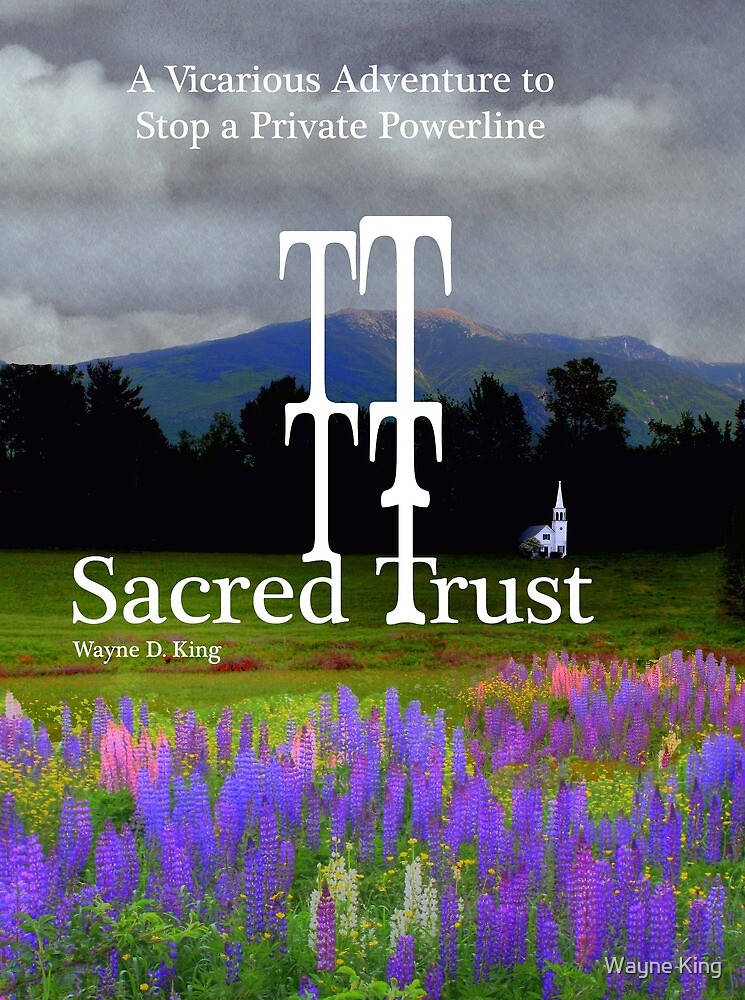
“Sacred Trust” is intended to tell that story in the context of a novel about a group of citizens that have joined together to stop the construction of one, especially egregious powerline, proposed in the small state of New Hampshire where tourism is the second most important industry and the people deeply cherish their beautiful mountains, clean air and pristine waterways.

The power company behind the transmission line, Polaris Electric, proposes to put most of the line above ground with massive 150 foot towers and intends to export 100% of the power right on through the state - like a giant extension cord - with no benefit to the people of the state. In short, like the oligarchs of a previous age, they intend to reap 100% of the benefits and to pass off a large portion of their costs through the generations-long visual pollution of the public commons, to say nothing of the decline in property values and the unknown scientific consequences of high voltage transmission lines on citizens living in their path.

The citizens of the state who stand to lose most from the destruction of real estate values and cherished viewscape are dead set against the project but the political winds are against them with a Governor in the pocket of the utility company and an approval process that seems to be rigged against them, eight unlikely compatriots from across the political spectrum come together to take on the consortium proposing the “Granite Skyway” Transmission line.

While the compatriots, who call themselves The Trust, engage in creative civil disobedience intending to stop the project, or at the very least to literally drive it underground, a group of writers and activists, presenting themselves in the style of the writers of the Federalist Papers produce a series of essays in opposition to Granite Skyway, making the intellectual case, justifying the actions of The Trust.  One business writer, in search of a pulitzer, takes on the task of describing the tableau in which all of this takes place beginning with the 1972 election of Jimmy Carter and the drafting of the National Energy Policy Act and the Public Utilities Regulatory Policy Act into which one lone New Hampshire Senator, John Durkin, inserted two lines that changed history and ushered in the renewable energy revolution.Through the device of a series of articles scattered through the novel, business editor James Kitchen leads his readers through a virtual primer of the battle for a new post-carbon energy paradigm.

"Sacred Trust" is a vicarious, high voltage adventure to stop a private electric transmission powerline that leads the reader through not only the hijinks of The Trust, but also through the series of choices with which we all are currently confronting, or will be, in this new “Age of Electricity”.

Described by one reader as "The Monkey Wrench Gang Meets the Third Industrial Revolution" the book follows these unlikely compatriots as they dodge both the law and a cabal of recruits doing the dirty work of the Consortium.

In part one of the book Sasha Brandt, an Iroquois woman from Canada who travels with her companion, a wolf named Cochise, meets Daniel Roy, a guide and outdoorsman while hiking the Mahoosuc Range on the Appalachian Trail. After a unique first encounter the two - three with Cochise - continue their hike together. A few days later, while paddling on Lake Umbagog, they find themselves unexpectedly camping together with an unusual assortment of people including a former Olympic paddler, a very conservative deer farmer, a real estate broker, a retired spook who was the first US victim of Lyme disease and an iconoclast named Thomas (just Thomas) who is also a former Army Ranger now living as a recluse in multiple backwoods abodes in the Great North Woods area of New Hampshire. Thomas is also unique in that his primary mode of transportation is a moose named Metallak, who pulls a cart when traveling with Thomas’ five dogs or wears a saddle when Thomas rides him solo.

The group quickly discovers that they have one very important thing in common - a deep concern about the Granite Skyway proposal to transport electricity from Canada to the toney suburbs of Boston, New York, Connecticut, Philadelphia and Washington D.C.. Their concerns range from the effect it will have on the habitat of newly re-established Raptor populations; to the clear cutting necessary to construct the line; and, the impact of 150 foot towers on the landscape of their beloved state.

The threat to the environment and the scenic beauty are only the tip of an iceberg that includes the value of homes, farms and businesses built by generations of men and women in this hardscrabble land. Rumors alone are already affecting life for many caught up in whisper campaign around this proposed transmission line. All agree, Granite Skyway poses an existential threat to an entire way of life.

Determined to do more than shuffle papers and employ lawyers, the compatriots form a band of brothers and sisters - along with Cochise and Metallak - calling themselves "The Trust". Armed with only their wits and a lot of heart they embark on a rolicking campaign of civil disobedience that would make Thoreau, Alinsky and Dr. King proud.

While the book is a work of fiction, teachers and professors may find it a book that would add a new dimension to classroom discussions and an interesting touch for classes on sustainability, renewable energy or the American tradition of protest.

Throughout their adventure the members of "The Trust" examine many of the most important questions of our time including how America can continue to make an honored space for free speech and civil disobedience in an era of terror; how social media can help create accountability in an increasingly corporatized mega-media landscape; and, how citizens can challenge the corporate oligarchies that often threaten our planet's future.

"Sacred Trust" is written by Wayne King a former State Senator, Democratic nominee for Governor of NH, and most recently CEO of environmental cleanup company MOP Environmental Solutions. Not coincidentally, King worked his way through college as a Mountain Guide in New Hampshire’s White Mountain which explains his detailed knowledge of the setting for the novel. The book is filled with political and environmental stories that will have you laughing and gasping and wondering what is true and what is fiction.

"Sacred Trust' is a vicarious, high voltage campaign to stop the Granite Skyway power transmission project and its short-sighted and in some cases greedy corporate sponsors, intent on using political muscle and money to lock up the region's energy production and distribution, short circuiting efforts to bring about an energy future based on sustainable, and renewable energy deployed through micro-grids, smart-grids and a competitive environment that makes energy more - not less - affordable.

http://bit.ly/STrust

Friday, October 20, 2017

One day left! Free Download October 19-21! "Sacred Trust"

One day left! Free Download October 19-21! "Sacred Trust" A vicarious eco-thriller where citizens take on a "Northern Pass-like" powerline project using creative civil disobedience to stop the travesty. To download the ebook go to Amazon.com and type in any of the following keywords: Eco-thriller, Creative Civil Disobedience, Environmental Action, Sacred Trust. The eBook is free for 3 days only (10/19-10/21). If you like it I'd appreciate a review from you but its not required.

Short cut link:
http://bit.ly/STrust


Wednesday, September 13, 2017

Revisiting the N. Korea Question


Its time to revisit the question of how we deal with North Korea. I'll say it: North Korea is now a nuclear nation. I don't like it but, hell, I don't like it that Israel, Pakistan, India and Russia are either. With Donald Trump as our President I'm not sure that there is a single nation in the nuclear club that isn't led by someone whose stability is up for question.
North Korea may be led by a nutcase but he is not wrong when he observes that many of the countries that have been convinced to give up their weapons of mass destruction have then found themselves in the sights of American military aggression.
It's time that we worked with China to implement the most aggressive sanctions we can while holding out the carrot of a thaw based on a nuclear non-aggression pact. We should never trust them as long as they remain under the leadership of a tyrant but trusting an adversary has never been a requirement of such a pact. In fact, we don't need pacts with those we trust, we need them with those we don't.


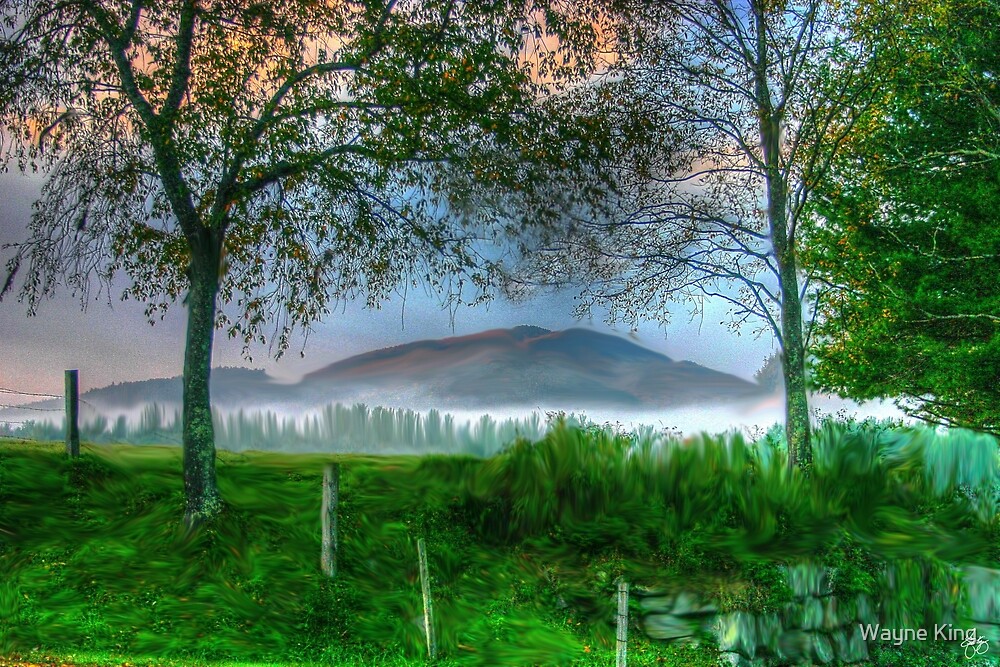
A Painters View of Tenney Mountain


Give Bill Gardner the Benefit of the Doubt


40 Years of Outstanding Public Service and Integrity have to Mean Something.

A lot of criticism has been levied at NH Secretary of State Bill Gardner for agreeing to an appointment to President Trump's Commission of Electoral Integrity. Critics say he is just encouraging a false narrative that Trump has promulgated for his own narcissistic reasons.

I Trust NH Secretary of State Bill Gardner. He has demonstrated during 40 years of public service that he is a fair and diligent arbiter and protector of a citizens right to vote and a fair, streamlined process for registering and voting.

While I would have been inclined not to accept an appointment to Trumps Commission on voter fraud because it is focused on trying to prove an assertion that is widely disputed by experts from all sides of the political spectrum. Nonetheless, I see the potential benefit to having a voice of reason among the members, many of whom have their hair on fire over the matter and are not expected to act rationally. Of course there is a danger to this approach. Gardner may find himself isolated and in the final analysis the story may be a lopsided vote for a report that has no bearing in reality. However, as a member of the commission Gardner will have credibility when he speaks out if this is the case. . . and I believe he will speak out.

In the final analysis, this was a judgement call. I trust Bill Gardner to fight for what is right not what is expedient.

Saturday, September 9, 2017

Re-imagining The Future as a Unifying American Journey - The Case for a Secretary of the Future

Wind in the Maple
Re-imagining The Future as a Unifying American Journey
The Case for a Secretary of the Future
Wayne D. King

Despite the constant drumbeat among the media and politicians, a careful examination of the seemingly deeply divided American people will show that the differences are a mile wide and an inch deep. This is contrary to the divisions between elected officials, which appear to be deep and perhaps lasting - though lasting is a relative thing in politics.

The need to register to vote and to choose between two political parties or to remain undeclared shoehorns every American into a largely binary process that has no constitutional authority but over time has created and assumed the mantle of de-facto authority. Nowhere in the Constitution is any authority conveyed upon either the Democratic or Republican parties. Yet both parties act as if that authority is vested in them and use the political process to erect barriers to entry by other parties. In California alone, for example, an independent candidate for President must have 1.2 million official signatories to a petition just to be listed on the ballot. Since each of those signatures is checked to determine whether they are registered voters, the process must actually gather about 1.4 million signatures just to make it over this high bar.

The intent of this article is not to make the case for opening up the process to permit more independent candidates for higher office - though I believe that and may address it in a future column - instead it is intended to make the case that the “deep” divisions between Americans that the media and the parties point to are artificially created by this binary choice. Where it matters most, at the risk of seeming to minimize some very important differences, we Americans are far more united than the polls would seem to indicate.

On the larger questions of the American idea, Americans are remarkably united. One need only look at the reaction to the tragedy in Charlottesville, Virginia and the President’s remarks following the events, to see that this is so. Polls conducted in the wake of Charlottesville showed Americans condemning the actions of White Supremacists and Neo-Nazis as well as President Trump’s response at a nearly 3-1 margin.

The mass resignations of business leaders from the President’s Commission on Business confirm this and would have continued had the President not stemmed the bleeding by eliminating two different business commissions entirely to avoid mass action being planned by other members. Business rarely takes such dramatic action without first holding a finger to the winds of public opinion. The President had, unintentionally created a moment of national unity and reminded us - just for a moment at least - of who we are and who we aspire to be as a nation.

Just as Americans are united in their loyalty to the American idea so too are they united in their fascination with and aspirations for the future.

These two bookends provide the framework for creating a unifying American Journey; a challenge that will cajole Americans into searching their national conscience and expanding their horizons to re-imagining and re-invigorating those ideas in an era of dramatic change and equally dramatic challenges.

In his last major interview before his death in 2007 the author and social critic Kurt Vonnegut suggested that there should be a cabinet level Secretary of the Future. His suggestion was treated by most as a quaint idea by a much beloved cultural icon. But Kurt Vonnegut had not intended to be quaint. He was deeply worried about the fate of the country and the planet. He was angered by the short-sighted politics of both political parties and he was concerned that we had lost sight of the connections that tied us together with all of the major issues in our lives and the fact that no one was helping to make those connections and helping us to re-imagine a future consistent with our values.

Vonnegut seemed to sense that our politics had been far outstripped by the pace of change and positing a cabinet level Secretary of the Future was intended to provide one way to create a formal means for looking at issues in a more holistic manner. Someone who could point out, as General Maddis did recently, that deep cuts to the Department of State would require more defense spending because less diplomacy would lead to greater conflict.

Even if our political system were not so badly broken we would still benefit from a Secretary of the Future who would be able to tackle the more thorny issues and provide some level of cover for those political leaders who have the courage to step into those waters.

The limited success in the past election of Bernie Sanders who - more than any other political leader in recent history - stepped into those waters with his calls for free public college education, Medicare for all healthcare and a $15.00 an hour minimum wage demonstrated that a significant number of Americans were not only open to those ideas but enthused by a candidate who had the courage to talk about them . . . even if they did not agree with every one of them. But politicians with the courage of Bernie Sanders are a rare breed. Most are careful, calculating, doing their best to stay - as Abraham Lincoln expressed it - “one half step behind the American people while acting as if they were leading.”

A Secretary of the future - or two such people, one representing more conservative thought and one representing more progressive ideals - would be in a position to introduce new ideas or even old ideas that have merit into the national conversation. Initially, the more cowardly members of congress would pooh pooh their ideas; but if Sanders is any indication, the American people will be more open minded and some of those ideas will take root.

I don’t expect that adding my voice to that of Vonnegut is going to make much of a difference here, and I certainly don’t see myself belonging in the firmament of icons like him; but if others lend their voices and even one candidate for President in our upcoming Presidential Primary calls for the creation of this position, or some equivalent idea, we will have created a spark that may grow into flame.

Just imagine if we had two national thought leaders, who were highly respected, appointed to help American re-imagine their future together;

Leaders who had no personal political aspirations but deep and abiding aspirations for the country;

Leaders who have demonstrated a knack for thinking creatively and for their commitment to American ideals;

Leaders with a charged to encourage and cajole the American people to confront our problems and challenges in new, or re-imagined ways, that inspire thinking and ideas bridging our differences where possible, and respecting them where they are deeply personal, religious or intransigent for other reasons but consistent with American ideals.

Whether it is facing the challenges of re-thinking an education system that meets the needs of a dramatic fast paced and highly automated economy; Creating a healthcare system that recognizes healthcare as a right not a privilege; tackling the growing inequality of income; building consensus for ways to meet the challenges of a changing climate; Or addressing the ever-growing challenges of expanding the cause of freedom and equality for all people in a diverse and dynamic country; The opportunity for us to gather around the idea of the future as a unifying American journey carries abundant promise. . . based on the premise that “where the people lead, the leaders will follow.”

About Wayne King: Wayne King is an author, artist, activist and recovering politician. A three term State Senator, he was the 1994 Democratic nominee for Governor and most recently the CEO of MOP Environmental Solutions Inc., a public company in the environmental cleanup space. His art is exhibited nationally in galleries and he has published three books of his images. His most recent novel "Sacred Trust" a vicarious, high voltage adventure to stop a private powerline has been published on Amazon.com as an ebook with the paper edition due soon. He lives in Rumney at the base of Rattlesnake Ridge. His website is: http://bit.ly/WayneDKing


Links and notes:


“where the people lead, the leaders will follow.” This quote is generally attributed to Ghandi but quite likely to have been used by philosophers dating back at least to the Renaissance.

Sunday, September 3, 2017

Wanted: Radical Centrists - No Political Experience Necessary

From: The View from Rattlesnake Ridge
Ruminations of an Unabashed Optimist, an Environmental Patriot and a Radical Centrist
by Wayne D. King
https://viewfromrattlesnake.blogspot.com/

Wanted: Radical Centrists - No Political Experience Necessary

It was Kurt Vonnegut, one of my favorite writers, who said that the United States needed a "Secretary of the Future". I've been thinking a lot about that lately partly because any distraction from the three ring circus that is the Trump administration is a welcome one but also because the future seems to loom larger and larger in the windshield these days.

Back when Alvin Toffler's "Future Shock" came out, followed by "The Third Wave", introducing us to the concept of a futurist and the dangers of ignoring the rapidly telescoping rate of change, it was a topic of great excitement and intrigue. It summoned forth the optimism and vision of JFK and gave us relief from the malaise of the Vietnam debacle.  It was all the rage for a while but somehow we got sucked into the sexy consumerist views of what was ahead and lost sight of the more significant social and economic consequences of change.  It was understandable. It was so much easier to dream about what gadgets we might see, or better yet might invent, becoming the next Steve Jobs or Bill Gates, than it was to think about what we were going to do to make sure every American - and every adult - found fulfilling work that allowed them to provide security for their families.

Today, only the most forward (and flush) corporations take seriously Vonnegut's charge to think about the future and to plan for it.

Failure to think seriously about the future, and just as important to innovate our way into it, has played a large role in the deeply divisive and partisan politics of our age. Democrats and Republicans are both guilty of short term thinking that threatens our future. Thinking little beyond the next election and how they can either maintain their majority or overturn the status quo - rarely thinking about what they will do beyond the silly platitudes that they regularly spew on the cable news networks.

Over the last decade both parties have killed off their own centrists and given us an increasingly polarized and almost monochromatic tableau of options at a time when options should be expanding as technology provides us with ever expanding choices for the way in which we live our lives and the opportunities before us.

At the same time the American people have become a technicolor dream coat of opinion and vision. Young people especially have rejected many of the conventions of the past to which we were bound, long since they have moved from antiquated "common sense" to absurd nonsense. A healthy proportion of the rest of us are glad to have the cover they provide so that we can speak and live the lives we too have longed for.

The political divisions of the country can be largely explained more as a result of the forced choice between the zany worlds of the Republicans and the moribund notions of the Democrats. As evidence of this one need only look at the fastest growing political affiliation in America today, Undeclared or Independent voters have eclipsed both political parties and the gap continues to widen with each election.

Divisions between elected leaders may be deep and growing but divisions among most Americans, at least on larger matters of consequence, are a mile wide and an inch deep and with leadership that helps us to embrace the best of what we are and to disagree without malice we can once again begin to believe in ourselves and our country again. Soon enough - - well, soon anyway - - we will place the Trump years firmly in the rear view mirror, seeing them as a bump in the road whose horror reminded us of who were really were.

But we will not do that without a common cause and that common cause can be the future; believing in it, preparing for it and innovating into it. We can start by restoring the center in our politics. Not the muddling middle but the radical center, challenging the margins to reach out to one another and build solutions that bridge the divide and push the envelope. Radical centrists who encourage us to trade short term "me first" politics for long term "we first" politics that embraces our common values, requires sacrifice and invests in the future.

Only "We the People" can make this happen. Congress, on this matter, is indeed the opposite of progress.  This is a revolution that must start from the bottom and work its way up.


** Next week: Secretaries of the Future - The Time has Come


About Wayne D. King: Wayne King is an author, artist, activist and recovering politician. A three term State Senator, he was the 1994 Democratic nominee for Governor and most recently the CEO of MOP Environmental Solutions a public company in the environmental cleanup space.  His art is exhibited nationally in galleries and he has published three books of his images. His most recent novel "Sacred Trust"  a vicarious, high voltage adventure to stop a private powerline has been published on Amazon.com as an ebook with the paper edition due soon. He lives in Rumney at the base of Rattlesnake Ridge. His website is: http://bit.ly/WayneDKing

Monday, July 31, 2017

Do We Need NATO Article 5 Protection from Cyber Attacks?

Article 5 Protection from Cyber Attacks
Wayne D. King

Before his term was up, President Barack Obama is said to have asked DoD cyber experts to insert sleeper viruses into critical Russian systems. These viruses could be activated in the event of future Cyber attacks from the Russians. The US should explore extending the protections of NATO's article 5 to cover cyber attacks. The Russians only seem to respond to strength. If they fear an attack on their defense infrastructure or their grid they will be less likely to continue their efforts to undermine the democratic systems of the US or its allies.
Of course it is likely that will mean that the Russians seek to do the same to the US. However, there is no guarantee that they have not already done this. In essence, until we can reach some accommodation on these matters, it would be a system of "mutually assured cyber-destruction" similar to that employed during the cold war.
Real Presidential leadership would invite the Russians to engage with us in the development of some form of "International Cyber Disarmament" Treaty. I won't hold my breath though.


Hope From A Mystic Portal - The Journey of Artemis II

  Hope From A Mystic Portal - The Journey of Artemis II For a brief time, all Americans' eyes have been trained on the heavens. Now, as ...