Monday, May 14, 2018

BAR THE DOOR! WE'RE HERE.


A Marine's Pride

As most of you know by now, my ancestors on my father's side were members of the Iroquois nation. To them we are all illegals. John Kelly's remarks on NPR made me wonder what the story was behind his own family history.

Here's a useful tidbit of information. File it under: "Bar the door! I'm here!" (General) John Kelly's ancestors, who arrived in America before we began classifying immigrants as documented and undocumented, included his Great Grandfather Giuseppe Pedalino and Pedalino's second wife Concetta. (Kelly's great-grandma died in 1898.)

Giuseppe Pedalino was a wagon driver. It is unlikely that he had more than a few years of schooling but we don't know this (yet) His wife was illiterate and could not speak English 10 years after arrival.

John Kelly's maternal grandmother Teresa is shown below as a child in the 1900 census. Her father, a day laborer named John DeMarco had been here for 18 years.

He had not become a citizen.
He could not read, write, or speak English.

The 1930 census shows his great-grandparents living with their daughter, son-in-law and grandchildren, one of whom was Kelly's mother.

John DeMarco had been here for 47 years and was STILL not an American citizen ("AL"). His wife Crescenza had been here for 37 years and STILL spoke no English.

pic.twitter.com/N9AfuLNvb1

These facts tell us a number of things:

1. In only 3 generations this immigrant family went from "the great unwashed" to the ancestors of the Chief of Staff to the President of the United States of America. That is nothing short of a true American success story.

2. General John Kelly is either completely ignorant of his own family's history or a hypocrite - I'm guessing the latter. This is less of a disappointment than his behavior in not having the courage to speak out against the treatment of John McCain at the hands of his own Whitehouse Staff but it's right up there.


Saturday, May 12, 2018

Democracy 2.0

Birdhouse Blues

Democracy 2.0
Democracy Should Be a Messy Business with Lots of Noise

Spring has finally come to Rattlesnake Ridge. Last night I asked Alice to add the Wild Leeks that I had gathered on my daily walk with Boof, our Siberian Husky, to the evening meal and it turned out to be quite delightful.

Our daily walk in the shadow of Rattlesnake is a time for reflection. Sometimes I listen to the latest book I have downloaded from Audible, but mostly I prefer listening to the birds and the angry Red Squirrels that chatter from the trees, or the bears that hoot and grunt from the woods.

Quiet, the absence of sound, is really not a good thing here. The sounds of a healthy environment - the sounds I hear beneath Rattlesnake Ridge - are the noisy sounds of life: leaves rustling in the breeze, a Pileated Woodpecker drilling for insects in an old White Pine, critters large and small celebrating the return of longer days and warmer weather and readying themselves for the days ahead.

A healthy community is the same way really. There is the daily buzz of activity but there is also the conversation, debate, agreements and disagreements that attend everyday life and local governance. Sometimes it’s enlightening, sometimes it’s more heat than light, sometimes it’s funny, and sometimes downright weird.

Take the case of the late Colonel Joe Kent. Colonel Kent - a rock ribbed Republican - played a major role in my first election to the Senate in New Hampshire. He was the Co-Chair, along with Doris Tunnell, of a group calling themselves “Republicans for King”.

“The Colonel”, as he was known around town was active in local government and he showed up for every town meeting, school board meeting and quite a few planning board, conservation commission and other meetings. He and his wife Ann - a loyal Democrat - also founded a group that would eventually preserve the Quincy Bog, a beautiful example of a glacial pond habitat now on its quiet way to field as the succession and eutrophication process plays out. It is a small place on the planet that is full of life and its wondrous cacophony.

Now Joe was a conservative guy; never threw out anything that he hadn’t worn to a frazzle. He had an old jacket, the kind we rarely see these days, with leather patches on the elbows. He loved that old coat. Ann did everything she could to keep that coat presentable because Joe liked to wear it when he attended the various town meetings. She sewed it, patched it, even replaced the elbow patches when they wore out. She was beginning the process of breaking the bad news to Joe that the old jacket was just too ratty to keep repairing. Then one day she simply gave up. Into the trash it went.

Two weeks later as Ann was putting away some other clothes, she discovered the coat hanging in Joe’s closet. He had retrieved it from the trash, possibly on his weekly dump run.

One evening, a few months later, Joe wore the coat to a meeting of the town selectmen - they were all men then - Joe had retired from this “prestigious” group a few years before but that night he had some business that he needed to discuss. The topic, lost to history I’m afraid, led to a heated exchange between Joe and the town fathers until finally, at the end of his rope, Joe got up and walked out. His last words to the board were “You’ve not heard the last word from Joe Kent on this!” Whereupon he walked out of the town hall and promptly dropped dead in the parking area.

When the people of the town gathered together to say goodbye to the Colonel, including many of those who had been in attendance on that last fateful night, some may have noted that he was wearing his favorite coat. Ann buried him in that old ratty jacket. She had a great sense of humor and irony.

I tell you this story because Joe and Ann Kent represented everything that is good and decent heart-warming and funny about the wonderful people with whom I share this special spot on planet earth. They participated in the life of our community in every conceivable way.

All over our country citizens are participating in the life of their communities in the same way. Lively and raucous debates are frequent, even encouraged, because they eventually find their way into committees, or teams, or ad hoc groups of people, rolling up their sleeves and getting down to the hard business of building consensus.

Too often, when we are bemoaning the divisions in our country, we pine for consensus but forget that the process for achieving it is often messy. In fact, the messier it is - the more often that citizens feel that their hands have touched it and they have been heard - the more likely it is that the middle will hold and consensus will be achieved. Bi-partisanship, civility, all of these things we feel to be in short supply these days are at the end of this rainbow but the rainstorms, the thunder and the lightning must come first.

The folks on Rattlesnake Ridge know this. Town meetings are never dull. Everyone who wants their say gets it. Usually it’s pretty civil but not always. A few years back, one attendee referred to me as “Comrade” suggesting that I was a big spender for wanting to see some improvements to the school. Months later that same fellow rescued Boof when he got away from me on our walk, we had a great conversation when I came to fetch him. Remarks made in the heat of the debate were forgotten and we were just good neighbors reaching out to one another.

Unfortunately, the folks who are leading our country seem to have forgotten all this. The procedures and rules that have been created in both the House and the Senate are designed to stifle debate and closely control the agenda. This process denies the American people the opportunity to understand the full range of opinions and options for resolving the issues we confront.

It also allows small groups of partisans, particularly those inclined to think way outside the mainstream, to avoid having to defend their positions openly, where we can see and hear the extent of their ‘crazy”. They are often able to quietly control the agenda without having their views exposed in their full measure.

Loon Island Misty Mindscape
Take the case of the United States Senate “silent” Filibuster. Today any Senator can choose to “filibuster” a bill by simply signing a form. Unlike the “talking” method of filibustering, so memorably depicted in “Mr. Smith Goes to Washington” by the great Jimmy Stewart, no Senator has to go through the uncomfortable process of debating the bill openly, or listening to the debate.

In both the House and the Senate, leadership of the majority party controls everything that comes to the floor and a Senate President or Speaker of the House decides what bills will or won’t receive a vote. This led, during the Obama Administration, to the nomination of a Supreme Court Justice, Merrick Garland, who never received a vote and thus was never seated, one of the great injustices in our Democratic history.

More recently, though there is broad consensus on the matter of the “Dreamers”, Speaker of the House Paul Ryan refuses to bring a bill to the floor because, he says, the President has not given any indication of what he will support and Ryan does not wish to deliver a bill to the President that he won’t sign. Ryan ignores the fact that the separation of powers, so carefully designed in the constitution, between the legislative and executive branches, presumes that Congress will act on what it sees as the best interests of the country and the President will take action on what Congress passes based on what he or she sees as the best interests. Congress is not subservient to the President, it is equal. Furthermore, such subservience did not keep Ryan from bringing no fewer than 30 bills abolishing the ACA aka ObamaCare to the floor, with no consultation with President Obama. His hypocrisy belies his deceit.

This problem exists when either party is in control of the House and the Senate. They may handle it differently but the results and the power plays engaged remain the same. Whether leaders are Republican or Democrat each is inclined to place their thumbs on the scales of debate and transparency.

Bringing such bills and resolutions to the floor is important, whether they will pass muster with the President or not, because this creates the opportunity for open debate, allowing the American people to take the measure of those making the case for passage or defeat of the legislation and, even more important, creates the opportunity for the public to hear the debate so that they better understand the ideas and their implications.

During the past few weeks a few small rays of light have shown through the dark shadows of Congress on this. In the House, a group of Democrats and Republicans have taken the first steps toward exercising a provision that allows a bill to be brought to the floor over the objections of the Speaker, specifically on the Dreamers act. If they continue in this direction the House will have the opportunity to vote on a Dreamers act, despite the Speaker’s roadblocks.

In the Senate a movement to create a law to protect the transparency of the Special Counsel’s findings in the Mueller investigation, even if the President removes him from his appointed office or uses the removal of some other appointee to try to limit the scope of the investigation. Republican Leader McConnell has indicated his opposition but members are pushing back and may be successful.

These efforts show some signs of hope but the central problem remains the same. House and Senate rules too often centralize control over the people’s representatives, contrary to the best interests of the American people and Democracy itself.

Democracy - or more specifically American Democracy - today is at a point of maximum danger. In an “Age of Accelerations” the world is moving and changing at a breathtaking rate. If Democracy is to move as rapidly and agilely, we need to make the process capable of meeting the challenges. Opening that process up, decentralizing it and giving power back to the people’s representatives will be much more noisy but also more transparent and productive.

If the Leadership feels they need something to do in order to be relevant, I suggest that they begin thinking about the future and crafting opportunities for members to debate, learn and discuss issues relevant to our future. It would be a nice change to have our representatives thinking ahead and beginning to ask themselves the big questions that will help us meet the challenges of the future instead of responding in crisis mode because we have failed to think about them.

Just as my noisy woods are a sign of a healthy environment; Just as my contentious and raucous community is a sign of a healthy democracy at the local level; Open, honest and thoughtful debate at the national level are needed to help us move from Democracy 1.0 to Democracy 2.0 without stumbling any more than we already have.

We need more debate, more noise, not less.

-=-=-=-=-=-
About Wayne D. King: Wayne King is an author, artist, activist and recovering politician. A three term State Senator, he was the 1994 Democratic nominee for Governor and most recently the CEO of MOP Environmental Solutions Inc., a public company in the environmental cleanup space. His art is exhibited nationally in galleries and he has published three books of his images. His most recent novel "Sacred Trust" a vicarious, high voltage adventure to stop a private powerline has been published on Amazon.com. He lives in Rumney at the base of Rattlesnake Ridge and proudly flies both the American and Iroquois Flags. His website is: http://bit.ly/WayneDKing


Storm Chasers

Friday, May 4, 2018

Wages continue to Stagnate

If you missed my column from 2 months ago about the Hidden Time Bomb in the unemployment numbers, I am reprising it today because 3 month have passed and the numbers still show the same troubling figures. . . and they will continue to until we face up to 45 years of stagnant wage growth.

"If you ever needed proof of the disconnect between Wall Street and average folks it is the response of the Markets to the unemployment numbers from last month. Not only were markets excited with the growth in the number of people employed but they were especially excited at the lack of wage growth. Their argument was that it means that inflation is not heating up; but lets call it what it is, a continuation of nearly 50 years of stagnant wages for middle class and working class families." http://bit.ly/WageStagnation

Monday, April 30, 2018

The Future of Work: The Gig Economy is Here to Stay.


The Gig economy is the term on the tip of the tongues of commentators and analysts these days. It’s a very broad term that describes both the increasing tendency of employers to hire independent contractors and short term workers rather than add new full time employees, and their accompanying taxes and benefits, to their workforce. It also describes a range of individuals who, by choice or necessity, build an income around work that is self-directed and without both the benefits and the downsides of a traditional job. A gig job may be a sole source of  income or performed in addition to a traditional job that doesn’t generate the income necessary to either the needs or the financial aspirations of the person involved.

The Gig Economy may seem to be a new phenomenon to many, but to folks who live in the shadow of Rattlesnake Ridge it’s been a way of life for a long time. When my friend Micky Lewis, whom you’ve met in this column before, delivers wood to my home in the middle of the winter, between snow plowing gigs, he’s supplementing work as a contractor that comes and goes with the vagaries of the economy and the real estate market among other variables. Now this is the life that Micky has chosen, but for many such work comes as a necessity. The trade off that many of us made to live here is that well paying jobs tend to be less available here.

So now the phenomenon has spread throughout the economy and we have a name for it, possibly named from the well known phrase “I’ve got a side gig doing . . .you finish the sentence”.  

The Gig Economy is not well defined. In fact, to date, no formal definition has been established even for the terms “Gig Economy” or “Gig Worker”. Furthermore, statistical information that really measures the number of people engaged in the gig economy is nowhere near the level of sophistication as those who are employed in the full time labor market. The Bureau of Labor Statistics has stubbornly clung to measuring three things: “Farm employment, non-farm employment and employers, there just aren’t that many gradations for job categories beyond that except by industry” according to the most comprehensive research on gig jobs I have found at Nation1099.com (see below).  

There are some understandable reasons for this. After all we are trying to measure not only those who make their entire living putting together gigs, both online and offline, as well as the people who have a job but supplement it with gig jobs; and those who label themselves consultants. In an effort to attempt to get a handle on this part of our economy the GAO issued a report in 2014 and could not decide whether the portion of workers that BLS defined as “Contingent Workers” represented 5% or 40% of the workforce.  It is estimated that as much as 90% of the jobs added since 2015, encompassing all three of these, have been gig jobs. 47% of Millenials, who make up the largest portion of the workforce, according to surveys are engaged in some level of freelance work.

A few other instructive bits of data are worth considering:

  1. According to Forbes Magazine, since 2000, 1099s have gone up 22%, while the traditional W-2 forms have stagnated.
  2. Some researchers project that half of the working U.S. population will move into the gig economy within the next five years.


Among the trends nationally that will have the greatest impact on the number of people in the Gig economy is the alignment of small business growth and Gig Economy growth. These days when most people think of the Gig Economy they think of big companies like Uber, Lyft, AirBNB, etc. but one of the fastest growing area of Gig Job growth is new and expanding small businesses who find it easier and more affordable to hire freelance workers than to add individuals to their payroll. This is partly due to costs but it is also caused by a new trend in business with jobs being broken down into component parts with the work divided between technological solutions (robots, software, etc.) and freelance workers for specific tasks that cannot yet be solved employing technological solutions.   

All of the trend lines indicate that the Gig Economy is here to stay. It will bring massive change, massive opportunity and massive disruption to the economy and our lives, making it both exciting and dangerous, particularly when combined with another trend in business, exchanging technology for labor. Most economists, futurists and other prognosticators predict that by 2020 almost half of the entire labor force in the US will be employed within the Gig Economy. That’s the same year, by the way that many say we will begin to see massive disruption in the largest source of individual employment, drivers as driverless trucks and automobiles begin the process of what very well may become a driverless society by 2050.

Now, the good news and the bad news. First, most people who are employed in some way in the gig economy indicate a high degree of satisfaction. Varying polls show a satisfaction rate of as much as 75%. They enjoy the flexibility and the freedom that it provides for them.

The bad news is that almost all of the people employed in the Gig Economy are within the middle class strata of society. Very few of the working class and poor, whom I have referred to as the Precariat, are currently engaged in this sector of the economy. Where there is massive income disparity between the wealthy and everyone else already, this threatens to make the problem even worse.

Furthermore most jobs within the Gig Economy have no benefits and therefore fall outside of the social safety net that we have constructed since the Great Depression.

Meanwhile, Trump Tweets, the Republicans hide and the Democrats are gleefully looking to 2018 without a clue of what they will do - other than to hold impeachment hearings -  if they take over the control of the House and/or the Senate. Granted, the Democrats have no power within the government but they could be setting an example by telling us what they would do if they did. It may be that their relationship with labor - which in fairness was largely responsible for building the middle class in this country - has paralyzed them. Labor has already been through a dramatic decline in America and they are fighting to maintain their clout. The Gig economy represents an existential crisis for them.  Unless the labor movement comes up with some new approaches to organizing, their days are numbered.

Here’s the problem in a nutshell, while we have moved to Workforce 2.0 in the global economy our governance is still stuck in Democracy 1.0 and Capitalism 1.0 and that is a real and growing problem. If I were advising an insurgent Republican candidate or an Independent Candidate for President I’d tell him or her to adopt a radical centrist agenda that spoke to the greatest threats to American economic stability and democracy. Go BIG or Go Home as they say.  It would take a whole lot of guts and it would be a high risk strategy. It might also be the first real step toward righting the ship of state and saving both capitalism and democracy.


Links:
http://nation1099.com/gig-economy-data-freelancer-study
http://www.forbes.com/sites/gregoryferenstein/2015/12/12/the-gig-economy-appears-to-be-growing-heres-why/
https://smallbiztrends.com/2016/07/20-surprising-stats-freelance-economy.html


About Wayne D. King: Wayne King is an author, artist, activist and recovering politician. A three term State Senator, he was the 1994 Democratic nominee for Governor and most recently the CEO of MOP Environmental Solutions Inc., a public company in the environmental cleanup space.  His art is exhibited nationally in galleries and he has published three books of his images. His most recent novel "Sacred Trust" a vicarious, high voltage adventure to stop a private powerline, has been published on Amazon.com http://bit.ly/STPaper. He lives in Rumney at the base of Rattlesnake Ridge and proudly flies both the American and Iroquois Flags. His website is: http://bit.ly/WayneDKing

Friday, April 27, 2018

The Value of Native American Indian Investment in America

In the last few months I have been thinking a lot about the values and obligations that we Americans share with one another.

In December I wrote a column that asked the question of whether GDP (also called GNP or Gross National Product) was the best way to measure American success and happiness. (InDepthNH.org - http://bit.ly/2I38p1q );

In February, I wrote a column titled "Restoring the American Voice" (InDepthNH.org http://bit.ly/2Kfuvyn) advocating the need for us all to moderate our differences by remembering and respecting those values that we all share. . . Singing the American Song together as we find our way through the sea of changes ahead.

In my March 3, 2018 column "A National American Social Dividend and a New American Paradigm" (InDepthNH.org http://bit.ly/2r1HYRB ) I suggested that we recognize an American Social Dividend. Essentially making the case that beyond the inheritance of private wealth that we have long recognized in America, that there should be a recognition of an inheritance of public wealth. A recognition of those contributions made over the centuries to the nation's wealth by those who are not in the 1%., including both the collective personal investments made (willingly or unwillingly) and the collective investments created by laws and institutions that have provided the legal and economic framework for a successful economy and a robust democracy. Those investments have played a role in the long term success of the American economy and our way of life that is every bit as important as the Plutocrat, who is able to pass along to his or her children the wealth generated during their lifetime. In fact, it could be argued that, without the robust institutions of Democracy, Capitalism - which is more of an "Operating System" than it is an ideology - could not have produced the rewards it has produced for those Plutocrats.

Now don't get me wrong. . . I am a "Capitalist" and there is nothing , in my opinion wrong with being wealthy; frankly, I wish I were. The sooner we stop denigrating people for being wealthy, or poor, the faster we will rediscover our American Voice. But the myth of the "self-made man" is just that, a myth. Behind every self-made man is an education financed by taxpayers, or a patent protected by a law and perhaps financed through a government research grant; a government infrastructure and a physical infrastructure, paid for by taxpayers at every level; or, a government guaranteed loan for a business . . . do I need to go on?

In the Column I cite just some of the ways in which, over more than two centuries, we have padded the GNP at the expense of one group or another concluding, finally that "in some way or another we are all aggrieved, we are all due reparations; we are mutually responsible for our successes and our failures and mutually entitled to an American Social Dividend paid for with the blood, sweat and tears of every American. . ."

Naturally in thinking about all this I began to wonder if there were not a way to show that both the political and economic success of our nation is grounded in the contributions and sacrifices of all Americans, even those who have been marginalized historically.

So I began to construct a series of questions that I wanted to try answering to help me better explain all this and to defend the proposition.


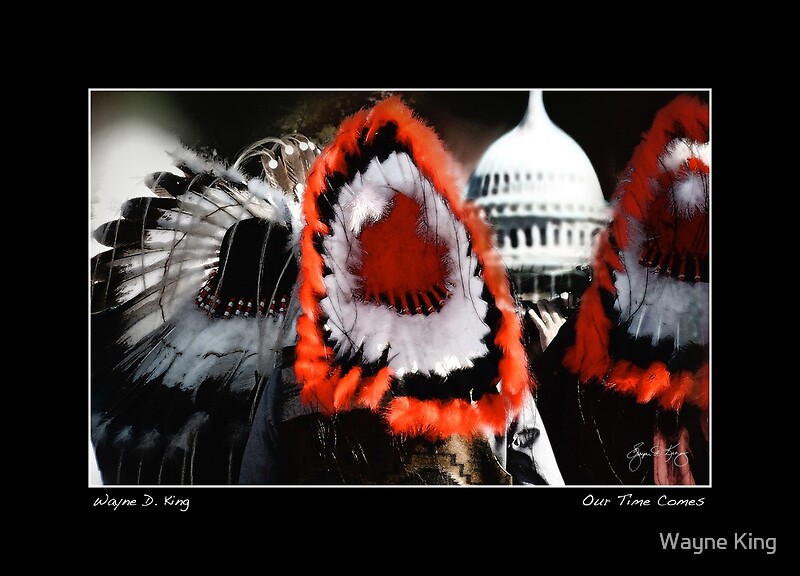
Our Time Comes


Here is the first question I asked myself (hey give me a break I'm Iroquois!) How does the value of the land taken from Native American people in the conquest of the US relate to GNP today?

As far as I know, no one has done extensive academic research on this topic and for good reason. It would be almost impossible - without Big Data and a powerful computer - to figure out, given differing land values and differing time tables, to say nothing of the fact that knowing when a land transaction was actually voluntary (not very often). On the other hand there is enough data out there to do a "back of the envelope" calculation generally, so here goes:

Using very rough estimates and not including the land taken from Native American people prior to 1776 and also not including improvements on the land such as the towns established in Georgia and the Carolinas by tribes like the Cherokee. It is generally understood that since 1776 Native Americans have been moved from lands totaling 1.5 Billion acres to a small set of reservations dotted around the country. If you simply use the general value of an acre of land prior to the Gold Rush ($1.25) the 1.5 Billion acres had a rough value back then of 1.9 Billion dollars. Using another rough calculation, real dollar values, we can estimate that $1.00 in the early 1800s is roughly (very roughly as we have no data related to inflation before 1913) equivalent to about $49.00 today. Since we know that no land in California today sells for $49.00 per acre (Average 2012 California farm real estate values set an all-time record - $7200 per acre) we can be sure that this is a conservative number, the value of the theft of native lands is, at a minimum $87 Billion dollars. If we use the $7,200/acre value, the value - still conservative - is 10.1 Trillion dollars. A glance at an estimate of the total value of US land is $14.48 Trillion dollars. The numbers show a surprising correlation. While about 80% of the lands of America were taken from native people after 1776, the value of that land today represents 70% of the total value of "unimproved" real estate (land only) in the US.

OK but the way we measure the wealth of our nation is not by real estate value, its by GDP. So how do we figure out what portion of the nation's wealth has been generated from lands taken from Native American people?

Well, let's try this: 18% of GDP is generated by real estate activity. 70% of 18% is 12.6%. GDP in 2016 was 18.57 Trillion. 12.6% of 18.57T is 2.32 Trillion dollars or 12.5% of 2016 US GDP generated from the 1.5 Billion acres of land taken from Native Americans since 1776.

While this is a seat of the pants calculation - I suspect the actual numbers would be higher - and certainly subject to legitimate criticism as there are many variables in the cost and value of land across the USA, the point made is the same. A large portion of national wealth has grown from the lands that we expropriated from Native American Indians.

Native people have not sought reparations. The loss of culture and marginalization for them has been far more important and can never be remunerated. It would be a step in the right direction to at least recognize that a substantial portion of our bounty today can be attributed to the land their ancestors called home.


About Wayne D. King: Wayne King is an author, artist, activist and recovering politician. A three term State Senator, he was the 1994 Democratic nominee for Governor and most recently the CEO of MOP Environmental Solutions Inc., a public company in the environmental cleanup space.  His art is exhibited nationally in galleries and he has published three books of his images. His most recent novel "Sacred Trust" a vicarious, high voltage adventure to stop a private powerline, has been published on Amazon.com http://bit.ly/STPaper. He lives in Rumney at the base of Rattlesnake Ridge and proudly flies both the American and Iroquois Flags. His website is: http://bit.ly/WayneDKing
-=-=-=-=-=-=-=-=-=-=-=-=-

If you know of better sources for the information on the back of my "envelope" I'd love to find out about them so that I can update this information. If you disagree with my points, I'd like to hear you, especially if you have a well thought out response and not just a snarky or snide remark. Lets have an honest dialog and we'll all benefit from it. wdk


Monday, April 16, 2018

Preamble - Critical Thinking and the Paradox of History

Lessons from a Lifelong Student (and sometimes Teacher) of History
Wayne D. King

"Skepticism is the chastity of the intellect, and it is shameful to surrender it too soon or to the first comer: there is nobility in preserving it coolly and proudly through long youth, until at last, in the ripeness of instinct and discretion, it can be safely exchanged for fidelity and happiness."
George Santayana
US (Spanish-born) philosopher (1863 - 1952)

History and politics must be approached with a large dose of skepticism whether from the left or the right because, after all, history is generally written by the "winners" whether their cause was just or not. While I may have coined, or simply adopted, the phrase "The Paradox of History" neither the phrase itself, nor the thought, is unique or original.

Economist John Maynard Keynes coined the phrase the “Paradox of Thrift” to describe that point in a recession when the public is inclined to save as much as possible and spend as little as possible, while at the same time massive spending is the only way to alleviate the economic peril that the country faces. The Paradox of history is simply that history is written by the “winners” who have a vested interest in the narrative, while at the same time, history's greatest benefit to us is what might be learned from an unbiased narrative that provides us an opportunity to see both the good and bad in its events, personas and results. Stated more eloquently by Gordon Craig, “the duty of the historian is to restore to the past the options it once had.”

So, therefore, a good teacher's first responsibility to his or her students is to convince them that they should believe as little as possible of what he or she is about to tell them. Let's call that the "educators corollary" to the Paradox of History.

Having admitted to complete and utter fallibility, a good teacher must then impart his/her knowledge assertively, as if no other source was closer to the oracle of knowledge and truth.

A worthy teacher, then, seeks not to serve answers or truths but to urge students toward the development of critical thinking skills and a healthy skepticism, from which they can derive their own narrative.

This does not in any way alleviate the burden upon you, the student. Quite the contrary in fact - it imposes a larger responsibility because you must find a way to demonstrate a modicum of deference to my years of experience and knowledge while, at the same time, double checking the veracity of everything you learn from me.
One of the first things that you will learn is that a good critical thinker does not mistake opinion or "common sense" for fact. Opinion, after all is just that; one person’s view of something. Common sense, that stalwart beacon of logic and wisdom with which your elders have urged you to imbue your thoughts and behavior, is an even more devilish force because it is empowered by the vast influence of majority thought.

Stephen Hawking, in his extraordinary "Science in the New Millennium" speech, said “. . . common sense is just another name for the prejudices that we have been brought up with.”
Facts, on the other hand, as Mark Twain said, are "stubborn things" they may stand by themselves or they may be turned into thought, but without them thought has no basis in reality; and, ultimately, no power.

So, as we begin this adventure, make it your goal to keep both your eyes and your mind wide open. Take joy in the moments in which your notion of the world is turned upside down because that is the surest sign that something useful is happening to you.

The Best Leader
Snow River

A leader is best
When people barely know
That he exists,

Less good when
They obey and acclaim him,
Worse when
They fear and despise him.

Fail to honor people
And they fail to honor you.

But of a good leader,
When his work is done,
His aim fulfilled,
they will all say,
'We did this ourselves.’

Lao-Tzu
Chinese philosopher
Wayne D. King

Sunday, April 15, 2018

Lessons from Geese

Colors in a Borealis Flyway

Taken from a Speech by Angeles Arrien and based on the works of Milton Olson

Fact 1
As each goose flaps its wings it creates an “uplift” for the birds that follow, By flying in a v formation, the entire flock adds 72 percent greater flying range than if a bird flew alone. LESSON : People who share a common direction and a sense of community can get where they are going quicker and easier because they are traveling on the thrust of one another.

Fact 2
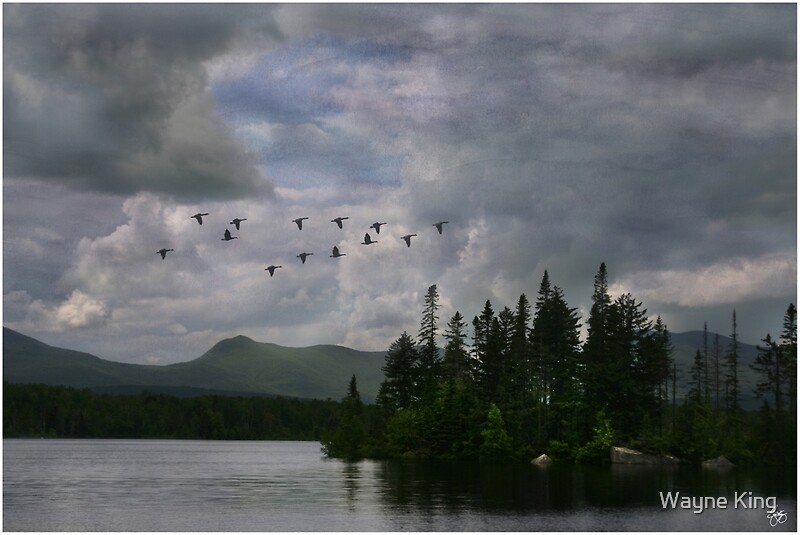
Goose Over Stinson Lake

When a goose falls out of formation, it suddenly feels the drag and resistance of flying alone. It quickly moves back into the formation to take advantage of the lifting power of the bird immediately in front of it. LESSON: If we have as much sense as a goose we stay in formation with those headed where we want to go.

Fact 3
When the lead goose tires, it rotates back into the formation and another goose flies the point position. LESSON: It pays to take turns doing the hard tasks and sharing leadership. As with geese, people are interdependent on each other’s skills, capabilities and unique arrangements of gifts,, talents and resources.

Fact 4
The geese flying in formation honk to encourage those up front to keep going. LESSON: We need to make sure our honking is encouraging. In groups where there is encouragement, the production is much greater.

Fact 5
When a goose gets sick, wounded or shot down, two geese drop out of formation and follow it down to help and protect it. They stay with the wounded goose until it is able to fly or dies. Then they launch out with another formation or catch up with their flock. LESSON: If we have as much sense as geese we will stand by one another in difficult times as well as when we are strong.


Painted Sky Over Jericho Lake

Hope From A Mystic Portal - The Journey of Artemis II

  Hope From A Mystic Portal - The Journey of Artemis II For a brief time, all Americans' eyes have been trained on the heavens. Now, as ...