Friday, March 9, 2018

The Hidden Time Bomb within the Good Employment News


If you ever needed proof of the disconnect between Wall Street and average folks it is the response of the Markets to the unemployment numbers from last month. Not only were markets excited with the growth in the number of people employed but they were especially excited at the lack of wage growth. Their argument was that it means that inflation is not heating up; but lets call it what it is, a continuation of nearly 50 years of stagnant wages for middle class and working class families.

Indeed, the unemployment news today is very good for the economy. Whether you wish to credit President Obama or President Trump is your call; economists make pretty good arguments both ways. Within these numbers, however, there is the long-term crisis of income inequality that represents the single greatest to the American Republic, there is also a ticking time bomb that threatens to lock it in . . . Non-compete clauses for hourly workers.

What? You say. If you have ever heard discussions about non-compete clauses in the past it was in conjunction with the employment of management level employees and people who are engaged in work that involves closely held intellectual property and trade secrets.

The fact is that since 2014 non-compete clauses for lower wage employees has been growing dramatically. It is now estimated that 25% of low wage workers are being required to sign non-compete clauses.

In year’s past there have been spurts in wage growth associated with a strong economy because employers had to raise wages in order to keep their workforce. Now they are requiring new hires to sign non-compete clauses instead.

Are you managing the line at a Pizza Hut and the local Papa John’s is offering to double your pay if you’ll come on board with them? Great news for you. Great news for your family too. Here’s your chance to take another step up the ladder of the American Dream. Hold on there! If you signed a non-compete agreement with your employee when you were hired - or after that - chances are that you are stuck. Worse still, you’ve got no leverage with your current boss because when you ask him or her for a raise - especially if you mention the offer from Papa John’s. He’ll just remind you that your non-compete clause means you can’t take that job. If you think you can take the job and accept the legal consequences, keep in mind that you may end up spending all or more of your increased wages on lawyers to defend you from your former boss.

Asking low wage workers to sign non-compete clauses is a blatant use of a legal contract clause intended to protect intellectual property to suppress wages for working class and middle income workers. If this practice grows we will have effectively locked in shrinking wage growth, especially for the poor and working class - the precariat - and made more desperate the hopes of overcoming the growing inequality of income in America.

To those who think this is not a threat to both the Republic and the economy I say, where will your consumers come from if this continues?

Alton Washday Revisited


About Wayne D. King: Wayne King is an author, artist, activist and recovering politician. He was a three term State Senator, who Chaired the Senate Economic Development Committee and the NH Senate Economic Summit. In 1994 King was the Democratic nominee for Governor and most recently the CEO of MOP Environmental Solutions Inc., a public company in the environmental cleanup space. His art is exhibited nationally in galleries and he has published three books of his images. His most recent novel "Sacred Trust" a vicarious, high voltage adventure to stop a private powerline has been published on Amazon.com as an ebook (http://bit.ly/STrust ) or in paper at http://bit.ly/STPaper . He lives in Rumney at the base of Rattlesnake Ridge. His website is: http://bit.ly/WayneDKing

3/9/2018

Sunday, March 4, 2018

A National American Social Dividend and a New American Paradigm

As the oldest, most successful republican system of government there is much about the American political, social and cultural systems in which we can take considerable pride. For more than 200 years, with relatively few exceptions - some notable whoppers among them - our system of governance and the people who have been elected, appointed and hired to represent us have served us well.

Each generation in that time has played its part in questioning, evaluating and putting to the test the institutions that we have created, allowing our government and our culture to continue to evolve. Sometimes that evolution came by renewing our allegiance to those institutions and sometimes by changing or even abolishing them. Sometimes the evolution of institutions has been gradual and sometimes by upheaval.
When the Republic was first established, the first ten amendments to the Constitution were essential to its adoption as the nation exercised its right to create changes to the structure and form of government right from the start. Insisting that the ten proposed amendments were essential to define the limits of power vested in the Federal Government and the essential rights of the individual and the states.
Likewise, over time, other amendments would codify the changes brought on by campaigns for change driven by the people and moving the country toward that “more perfect union”. In 1865, following the greatest single test of the young nation, and the loss of more than half a million American lives, the thirteenth Amendment ended America’s greatest shame, slavery. In 1869 it became illegal for a man to be discriminated against in voting based on race, though women, to our everlasting regret, would remain completely disenfranchised for almost a half century more and most of those covered by the fourteenth amendment would also not fully realize their franchise until even more time had passed. In 1912 Senators, who had been selected by state legislatures for the first 125 years of the United States system, were selected by direct election of the people for the first time and six years later women finally obtained the right to vote after a long and hard fought campaign for suffrage.
Like the then-emerging understanding of natural law, propounded by Charles Darwin, so too did it seem that the process of evolving toward a more perfect union was one in which competing forces served to dictate the speed of that evolution, driven by a complex algorithm of activism, courage, perseverance and patience.

It also seemed, until fairly recently, that with our system of governance, so dexterously woven by the founders, they foresaw within its structures and institutions that there would be a natural obsolescence, the result of the nexus of time, human endeavor and achievement pushing forward the evolution of society.

Each of these major political changes as well as those wrought by social and economic forces including two Industrial Revolutions, the Labor Union Movement, The Progressive Era, The Women’s Suffrage Movement, the Great Depression, two World Wars, the Civil Rights Movement and the Cold War, merged with the political changes to create ongoing movements and moments defining continuously reinvented versions of the American Paradigm.

But in the last two generations something has happened to this natural progression . . . something has changed.

If you are a Millenial or from Generation X you may not have noticed. That’s because the changes seem less dramatic when viewed in the scope of 20 years than over more than half a century.

Each generation of Americans have faced this to some extent but the leap from horses and buggies in the late 1800s to fast cars and SUVs in the late 1900s is not nearly as mind-blowing as the changes that have taken place since the turn of this millenium.
Today the world is shifting beneath our feet. Change is not only the rule, it is both friend and foe. To make matters worse, it is often difficult to distinguish between when it is friend and when it is foe.
As important as the rapidly accelerating pace of technological change is to understanding where we are and where we are headed, what is even more important is to acknowledge that there has been a dramatic decoupling of the responsiveness to change between those driven by the human spirit, innovation and entrepreneurial initiative and our increasingly moribund and tribalized national politics that threaten to infect our state, local and community politics.

Even those of us who are Boomers have accommodated ourselves to the rapid pace of social change, as difficult as that may seem from time to time. Every day we hear new stories of entrepreneurs who have created remarkable new products that solve real problems. The pace of these victories of the human spirit and the entrepreneurial ethos continues to accelerate; but the ability of government to respond seems inversely proportional to its size and level. The further government is removed from the people the less dynamic it seems to be in its capability to respond to change and the more partisan it has become.
Until recently our political institutions have seemed to be up to the task of evolving with the culture and the economy. No more. In fact, they have been out of sync for some time now, the lag, it turns out, was in our understanding of this.


The Collapse of Middle Class and Precariat Income and Wages
Believe it or not, 1973 was the last year that wages for the Middle Class and the Precariat rose in response to increasing productivity. Since that time wages for both have stagnated while the real income of the top 1% has risen dramatically.

This growing income gap is the greatest threat to our democracy and our most important challenge as a Republic. Furthermore it is a virtual iceberg of sadness, rage and division within our society. Where most of the danger lies beneath the surface of the water. One need only observe that the margin of Hillary Clinton’s loss to Donald Trump in the 2016 elections can be found in the number of people who voted for Barack Obama in 2008 and 2012 - desperately seeking hope - and then having found that still no one seemed to be listening - they voted to burn the system down by switching to Donald Trump.

This collapse and the growing disparity of income in America represents a grave and existential danger to our Republic. The stability of a democracy is built on the strength of its middle class and the belief that even those in the Precariat can aspire to moving up . . . the belief that if you work hard and play by the rules that every American has the opportunity to succeed. When people begin to lose faith in this the Republic is in peril.

Equally as important, though rarely observed, this disparity represents a nearly complete denial of what has contributed to an American economy that is second to no other in humanity’s history. The Gross Domestic Product of our nation is a complex synthesis of recent success and hard won achievement built over more than 500 years of history.

Try telling the families of the Creek, the Cherokee, the Chocktaw, the Chickasaw and other nations who unwillingly participated in the death march now known as the “Trail of Tears” that some of the wealth of this great nation, reflected in its GDP today, did not come from the theft of their lands and wealth or that of any of the other 558 other tribes within the United States that have managed to survive the informal genocide of disease and the more formal one of the eradication campaigns that followed them.

Try telling the descendants of African American slaves who, for more than 200 years, padded the numbers of the national GDP with free labor that their toil and pain played no role in the equation.

Try telling the women of this nation, who even today earn less than 80 cents on a dollar compared with men in the American economy, that their labor is not of equal value and worthy of recognition in the equation.

Try telling the descendants of every immigrant group that came to this nation seeking opportunity and endured the slings and arrows of xenophobia and prejudice while providing low wage labor to generations of American Oligarchs; or the families of Japanese Americans held in prisoner camps during World War II and stripped of their wealth that their sacrifices in the national interest don’t matter.

I could go on but my point is not to dredge up the mistakes of the past but rather to recognize that - as a nation built by immigrants on lands stolen from indigenous people, we are all aggrieved, we are all due reparations. We are mutually responsible for our successes and failures and mutually entitled to a National American Social Dividend paid for with the blood, sweat and tears of every American who labored, and fought for the American Dream over the past 500 years - even before the dream was fully formed.

Mutually Entitled is the key phrase here. This National American Social Dividend is the birthright of everyone from the richest oligarch to the poorest American cobbling together four minimum wage part-time jobs to keep his or her head above water. Recognizing this will be critical to solving the problems associated with it lest it simply become one more flashpoint in the ongoing culture wars and tribalism that pits one American against another.

Back in the early 1970s when wages had not decoupled from productivity and the share of the wealth the bottom 99% of wage earners was still growing it seemed that we might see ‘the invisible hand of the market’ adjust accordingly to correct for the problem of income disparity, but time has a nasty way of revealing to us the truths behind our sacred cows.

In the last decade, time has, like a capital black hole, collapsed on itself in a landslide of cascading realities that have shaken our confidence in the American system to the core.
American productivity has never been better, yet productivity has produced a rush to the bottom in marginal costs of products, great it you are a consumer - but fewer and fewer of us find ourselves able to afford the luxury of being consumers these days.

American productivity is rarely today referred to in the quaint old fashioned parlance as “worker productivity” because fewer and fewer workers actually lay hands on the products. Astounding gains in artificial intelligence will only serve to make this problem worse and this train has left the station, there is no turning back.

Depending upon what futurist or prognosticator you are listening to between 40% and 60% of existing jobs will be performed autonomously within a decade, requiring few if any human hands earning wages. Even some of the newest jobs created within the “Gig Economy” like Uber Driver will vanish while the driver’s seat is barely warm. Within ten years almost all jobs related to transporting passengers and freight will likely be driverless as will many others that require only rote learning. Even a significant number of jobs that we would not imagine capable of being performed by anything other than a human will vanish without a trace.
There is no consensus about whether this dramatic job loss will be accompanied by equally dramatic growth of new jobs. Historically the case can be made that such revolutions in employment generate more jobs, not fewer. However, it’s worth asking ourselves if there are any trends that run contrary to this optimists outlook.

According to Mark Blyth, Professor of Political Economy at the Watson Center for International Studies at Brown University, 94% of jobs created since 2008 have been agency contract, part time jobs - most without benefits. If this trend continues, and there is no reason to believe it won’t, the majority of Americans will no longer be working a single job but multiple jobs, again with few, if any, employer provided benefits.

The stress that this has already exerted on the fabric of America can be seen in the growing partisan divisions of our politics, in the tribalism that pits one American against another even to the point of casting aside some of our most cherished beliefs including our pride in our own immigrant heritage and the role it has played in creating the most diverse and vibrant democracy on the planet.
All of those people who took such pride in the election of Barack Obama as President did not just abandon their core beliefs to choose Donald Trump. They came to believe that the light they saw at the end of the tunnel was - in fact - a train coming at them full speed. Fear has a powerful way of changing our perceptions.

Thomas Piketty said, in his landmark work “Capital”, “The natural course of capitalism is the concentration of wealth.” but there is a solution to this. A robust democracy that doesn’t accept it as a fait accompli. Assigning blame is counter productive. This is no-one’s fault, but it is everyone’s problem. Overcoming it will be the great challenge of our time. It will require us to reinvent many of the institutions that have defined us over the centuries. It will require us to find new ways to bridge the divides that threaten us. It will require Democrats to embrace smaller government and Republicans to accept economies of scale. It will require those who would prefer to punish the poor for being . . . well, poor . . . granting them more freedom and responsibility and require those inclined to act as nannies to enfranchise the poor with the freedom to fail. It will require that we do not downsize government or upsize government but rightsize government, vesting power where it is most effectively wielded.

It will require us to create a new American Paradigm including a means for accessing and employing a National American Social Dividend as a means for creating a pathway to national renewal.

About Wayne D. King: Wayne King is an author, artist, activist and recovering politician. He was a three term State Senator, who Chaired the Senate Economic Development Committee and the NH Senate Economic Summit. In 1994 King was the Democratic nominee for Governor and most recently the CEO of MOP Environmental Solutions Inc., a public company in the environmental cleanup space. His art is exhibited nationally in galleries and he has published three books of his images. His most recent novel "Sacred Trust" a vicarious, high voltage adventure to stop a private powerline has been published on Amazon.com as an ebook (http://bit.ly/STrust ) or in paper at http://bit.ly/STPaper . He lives in Rumney at the base of Rattlesnake Ridge. His website is: http://bit.ly/WayneDKing

Saturday, March 3, 2018

Income Inequality - America’s Greatest Single Challenge in the Age of Technology

Wayne D. King

I believe that income inequality is the greatest single threat to our nation. If we do not begin to talk seriously about how we address this - and not the simplistic pablum that both Republicans and Democrats have fed us for the last 50 years - then the Republic is in grave danger. We will pinball from one ideologue on the right to one on the left.

"The world is shifting beneath our feet. Consider this:

1. Since 1973 wages and income for the bottom 99% of Americans have been stagnant. That means that every year growth in the economy is transferred directly into the bank accounts of 1% of the population.

2. The marginal costs of products move ever lower in response to enhanced productivity but that productivity is purchased by an unstoppable wave of technology displacing workers.

3. 94% of the jobs added to our economy since 2008 have been agency conntract part time jobs most without benefits and within the next 20 years 40-60% of all jobs that exist today will be replaced by technology.

4. For the first time in 100 years average American lifespans have gone down over the past decade. Some of this can be attributed to the Opiate crisis but a large share is the due to the fact that even a health club membership is out of reach for many Americans and expensive prescriptions are out of the question to many.

I ask the same question that I asked in my column of January 1, 2018 ("A Steady Hand and an Open Heart" http://bit.ly/ASteadyHand) Who will buy the products when technology has replaced the human hands that once made them? To whom will those products be delivered when the trucks delivering them are driverless or they are flown through the air by drones? Where will we employ the taxi drivers, the line workers, the coal miners?"

Every American has contributed to the success of our economy for 500 years. We must find a way to share in those fruits in order to unleash a new entrepreneurial vision and spirit and to shrink the need for a safety net because more people are sharing in our economic success.


Next column: A National American Social Dividend and a New American Paradigm

Thursday, March 1, 2018

Time to put 16YO voting age on the table.

Time to put 16YO voting age on the table. Parkman kids have made it clear that our young people can participate responsibly and are as informed as any average voter. #Let16VOTE

Wednesday, February 28, 2018

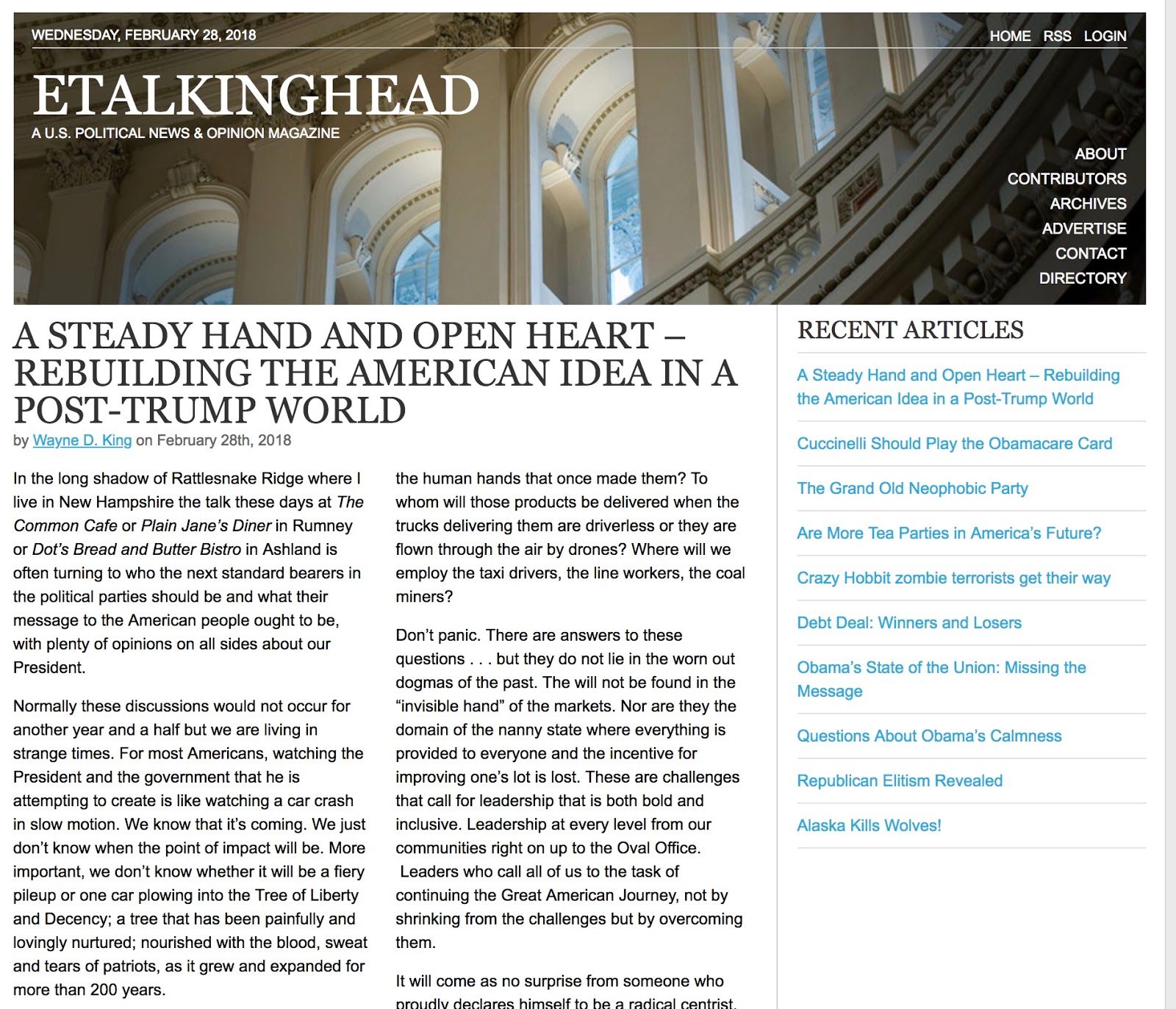
ETalking Heads

A great space for political writing of substance on the web.


http://www.etalkinghead.com/ 

Why there has been no proof of collusion with Russia YET.

There's been a lot of talk this week about why there has not yet been any collusion shown in the Russian investigation. My sense is that Robert Mueller knows that the President will take some desperate action when he realizes that the noose is tightening so Mueller has to make it impossible for them to remove him without further implicating the President and his administration. The only way to do this is to bring the hammer down all at once so he's likely holding back the biggest pieces of what he has been working on in order to release it at once.

wdk

Thursday, February 15, 2018

Creating Common Cause - Restoring the American Voice


Standing atop Rattlesnake Mountain gazing down at the Baker River as it winds its way down the valley from its headwaters in Wentworth to its confluence with the Pemigewasset River in Plymouth there is a sense of peace . . . a sense of place that one feels.

I go there from time to time, in body or in spirit, to be reminded of what Camus said: “In the depth of winter I finally learned that there was in me an invincible summer.”

I seek out that summer at times like this, when the chaos in Washington and the world begins to overwhelm me. When one tweet storm after another sweeps across the country blotting out all of the other crises in need of our attention. That invincible summer somehow creates the space for me to continue on.

The most recent distractions began with a memo sandwich over the Russia imbroglio; “the Nunes Republican memo” to which the entire intelligence community had objected but was released by the President over their objections; followed by a second memo “The Democrat’s Memo” that the President just could not release because of the objections of the Department of Justice.

In the middle of this memo sandwich, was The State of the Union Address - the second longest such address in American history - It wasn’t until he had finished that I realized the President had spent more than an hour telling us about all of the fantastic things he had done and never once spoken about our collective future . . . our American Journey.

The speech was filled with “I’s” and “me’s” and few - if any - “we’s”.

Call me an incurable romantic but there is something about the State of the Union Address that leads me to expect my president to tell us where he - or she - sees us going together in the future. Looking to the future together creates shared moments that encapsulate our hopes and our dreams. It even helps us to tame our fears from time to time.

Dreaming together is a fundamental part of the process for defining, redefining and reinventing ourselves. It is the expression of an ever evolving American Voice - constantly filling in the spaces between “We hold these truths to be self evident” with the inspirational ideas for building a “More Perfect Union”.

Yet, in over an hour of boasting and braggadociousness, Donald Trump never called on Americans to dream together; never engaged our American Voice; never sang our American Song.

Yet somewhere, in the back of our minds, most Americans - including those who voted for Trump - can still hear that song. The song that we share, the bond that we share, the nexus between what we all recognize as fundamental American values and our willingness to engage one another in the journey to define a more perfect union. This has been the glue that has held us together through some of the most challenging times in our history. That is the American Voice.

Now, more than ever, we are called upon to embrace those fundamental values.

The American voice is being shattered into a babel-like cacophony and we must fight with everything we have to recover it. Not because The American Voice alone will save us from the crises ahead . . . it won’t . . . but because it will provide us with common ground to talk with one another and a common cause that will keep us from falling into an ever widening rabbit hole of fear and retribution driven by the political extremes in their efforts to either advance an extremist agenda or exact retribution from those advancing such an agenda.

Almost every American recognizes that major changes are roiling our economy and our geopolitical world, happening at an ever increasing rate. New York Times Columnist Tom Friedman describes this as the age of accelerations. The days of the simple Command Economy vs. Market Economy are drawing to a close. The left vs. right debate no longer serves us well, if it ever did. We are a nation in search of a new paradigm. A paradigm that remains true to the central ideas and ideals of the American vision of Life, Liberty and the Pursuit of Happiness. A nation with a place for everyone: Where the working class is not marginalized; where the wealthy are not villainized; where the poor have a real pathway out of poverty, where the middle class is expanding, not shrinking; where it matters not what your skin color is or who you choose to love or what you choose to call yourself; where the opportunity for a meaningful life is recast to reflect a new set of realities and participation in the ongoing Great American Journey is an imperative.

In order to define and build this new paradigm we will need to be able to speak with one voice - One American Voice - respectful of our differences, bold enough to honor the traditions of our founders, challenging the people to help define this new paradigm, crafted by evolution not revolution and built from the center out, not from the margins.

In other words, like a gyroscope on a rocket that prevents over-compensating in the blink of an eye turning one odd movement into an uncontrollable series of gyrations that tear the ship apart; We need the common ground of our American Voice and shared American Values to serve as a ”governor” - moderating the reaction when the “Heat of the Moment” will tempt us toward over-reaction. We must find a way to stop screaming at one another and begin listening . . . moving our country forward.

Over the next few weeks, I intend to use this column as a way to propose a series of interconnected ideas for moving beyond the current divide. Ideas for strengthening the American Voice and building a new entrepreneurial American economy and community.

The changes that will be required to address these new challenges we face will not be simple. The challenges that have led to where we are today are momentous and they require big ideas and solutions. If we employ our American Voice toward a civil discussion we can take on even the most intractable challenges: dramatic and increasing income disparity coupled with an unstoppable tsunami of automation that will continue to disrupt the economy and the jobs of almost every imaginable field of work and endeavor; Increased tribalization within the American community pitting rich against poor, Democrat against Republican, urban against rural.

You will not be surprised, from someone who proudly claims to be a “Radical Centrist”, that I believe one reason for this is the extremists in both political parties who have declared war on their centrists. Part of the case I intend to make over the next few weeks is a case for strengthening voting rights and watering down the power of political parties.

I also intend to make the case for National Service. It was Gandhi who said “The best way to find yourself is to lose yourself in the service of others.” These words reflect what many others have said . . . that the greatest beneficiary of public service is the person who serves, not the person served. Service creates a touchstone we share with one another. It takes us out of ourselves and puts us into the shoes of others.

National service - either civilian or military - should be a legacy requirement of the American journey. For every American it could be a transformational moment in both their personal journey and our collective one.

The benefits of national service accrue to both the individuals who serve, those who are served and to the country in whose service the individual labors. There is a power to the nexus of the three; synergies that can have the effect of strengthening the bonds between diverse people, creating a sense of community.

Probably most controversial, at first blush, will be the case for a universal basic income. A legacy payment to every American citizen based on contributions to the wealth of our nation made since 1492. You might be surprised at the people who have made the case before me including conservative economist Milton Friedman and Libertarian icons as well as titans of technology who see it as a way to unleash America’s entrepreneurial spirit and to free the middle class and the precariat from the yoke of unnecessary regulation and bureaucracy.

This is not to neglect other fundamental aspects of renewing the American idea in a post-Trump world. Education is a core value that will require fundamental change to reflect the world in which we live as is the nexus of science and morality.

Let’s take a journey together . . . Americans all.


About Wayne D. King: Wayne King is an author, artist, activist and recovering politician. He was a three term State Senator, who Chaired the Senate Economic Development Committee and the NH Senate Economic Summit. In 1994 King was the Democratic nominee for Governor and most recently the CEO of MOP Environmental Solutions Inc., a public company in the environmental cleanup space. His art is exhibited nationally in galleries and he has published three books of his images. His most recent novel "Sacred Trust" a vicarious, high voltage adventure to stop a private powerline has been published on Amazon.com as an ebook (http://bit.ly/STrust ) or in paper at http://bit.ly/STPaper . He lives in Rumney at the base of Rattlesnake Ridge. His website is: http://bit.ly/WayneDKing

Hope From A Mystic Portal - The Journey of Artemis II

  Hope From A Mystic Portal - The Journey of Artemis II For a brief time, all Americans' eyes have been trained on the heavens. Now, as ...